
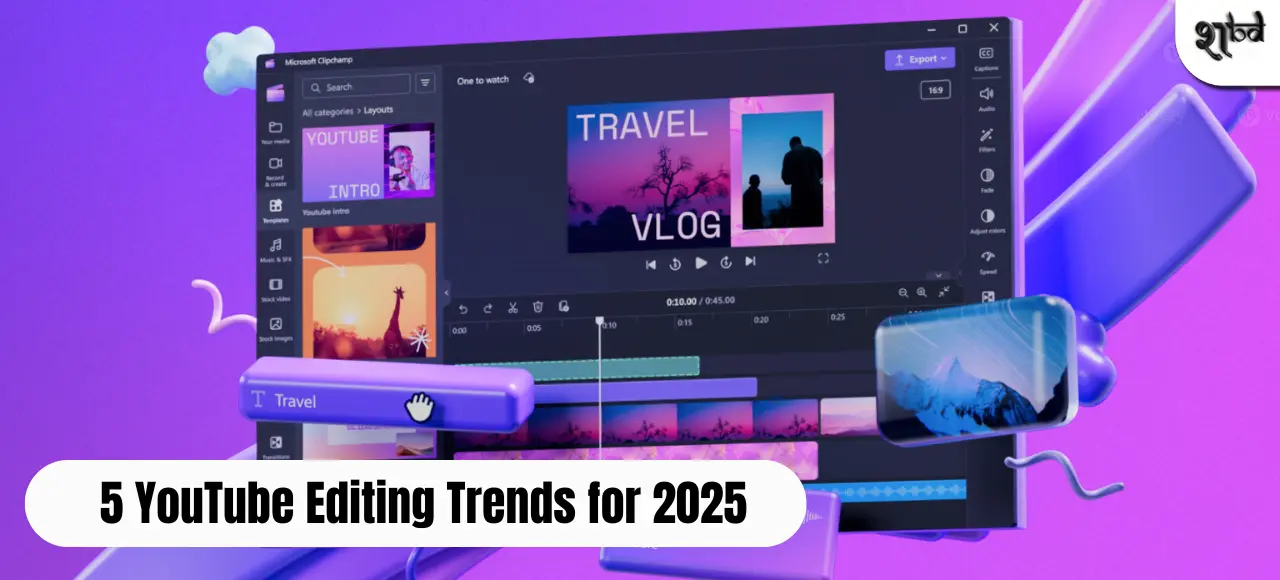
5 YouTube Editing Trends for 2025 You Should Know
Cuts and transitions are no longer the only aspects of editing. The entire video editing process has changed as a result of the development of AI and intelligent workflows. Creativity, storytelling, and strategy are now more crucial than ever, even when manual labor has decreased. This change ushers in a new era in editing and presents new chances for artists worldwide.
These days, editing seems quicker, more intelligent, and much more imaginative. A whole new approach to visual storytelling is being shaped by cloud-based editing, immersive sound design, short-form video formats, and AI-powered tools. The seven newest trends in video editing for 2026 are discussed in this blog, along with how they will change editing going forward. Additionally, you will learn about contemporary editing methods and the fundamental tools that all editors should begin mastering right now.
Trend 1: AI & Automation
Whether you’re a novice or an expert video editor, you’ve undoubtedly observed how AI has fundamentally changed the editing process. Rough cuts and synchronizing, which used to take hours, can now be completed in a matter of minutes. For editors, AI-powered tools have really changed the game. Examples include:
- Runway ML
- Descript
- Adobe Sensei
- Pika Labs
All these tools assist editors through AI automation, which includes tasks like:
- Removing unwanted clips
- Syncing dialogues
- Generating background shots or AI-generated visuals
AI automation has introduced new creative tensions—if everything becomes automated, how will editors preserve originality?
Today, almost every modern editor is facing this challenge. Editing is not just about cutting clips; it’s about emotionally connecting with the audience through visual storytelling. With increasing AI automation, maintaining this human connection has become more complex.
Storytelling feels authentic only when human emotions blend naturally with AI-assisted workflows. After all, AI should remain a powerful tool—not the creative director.
Here are some important tips to help editing students:
- Learn to guide AI rather than blindly following it.
- Focus on prompt writing and creative decision-making.
All of this sets you apart from AI. In the coming years, AI automation will become a major part of filmmaking and editing—but the editors who use it creatively will lead the next generation.
Trend 2 – Vertical / Short-Form Video Editing
Short-form videos have completely reshaped editing trends in 2026. Storytelling rules are evolving as audience attention spans shrink from minutes to mere seconds. To stay relevant, editors must adapt their style for trending platforms and optimize content across multiple formats.
- Instagram reels
- YouTube shorts
Getting the viewer’s attention in the first three seconds—the time that determines whether they scroll or stay—is the most difficult task for editors. Because of this, short-form video content requires the ideal ratio of creative speed to visual clarity.
The rise of vertical videos has completely transformed how editors think and create. Every cut, motion text, and beat must now tell a story within a compact screen space, where every second matters. To keep viewers hooked, editors rely on:
- Split screens
- Zoom-ins
- Smooth transitions
Once you master expressing emotion in just 60 seconds, longer edits automatically feel more powerful and natural.
Students may experiment with quick cuts, text layering, and flawless music sync thanks to this trend. You can keep ahead of YouTube editing trends and video editing forecasts for 2026 by remaining flexible in this way. Because those who can add depth, even to short-form content, will ultimately own the future of video editing.
Trend 3 – Remote Collaboration
Studio rooms are no longer the only places to do editing. Editors may handle projects from anywhere in the globe if they have a laptop, a reliable internet connection, and the necessary tools. Real-time collaboration on the same timeline is made possible by platforms like Frame.io and Blackmagic Cloud, which speeds up and improves the process. Editors may work from one place and get immediate response from clients or teams in another thanks to cloud-based workflows.
This evolving editing landscape is a big advantage for students. With remote collaborations, you can:
- Enroll in remote internships
- Take up freelance projects
- Build a portfolio while working with global teams
Collaboration is more than simply a talent in 2026; cooperation and communication are just as important as editing. Keeping up with this trend gives you a comprehensive understanding of the newest methods for video editing as well as editing forecasts for 2026.
If you want to be a part of the future of video editing, you should learn some skills, including:
- Project sharing
- Live feedback
- Sync workflows
Trend 4 – AR / VR / 3D Editing
Today’s editors are creating entire visual universes; editing is no longer limited to the timeline. As AR, VR, and 3D editing have grown in popularity, storytelling has become a completely immersive experience. Audiences now experience the situation rather than just seeing it. For this reason, the main trend in video editing for 2026 is immersive content.
Now, every project feels more detailed and real with tools like:
- 360° video
- AR filters
- Volumetric capture
The following software allows editors to experiment with 3D environments and motion elements:
- Unity
- Unreal Engine
- Adobe Aero
These forms improve branding and learning in advertising and education, and they foster a closer bond with viewers in entertainment.
Students have an amazing chance to learn AR, VR, and 3D editing as spatial video design and thinking beyond the conventional 2D frame have become critical skills. The genuine future of video editing, where lighting, textures, depth, and color trends influence emotions and narrative, is reflected in this growth. The upcoming generation of editors will define visual experiences in this potent creative area, which is more than just a technological improvement.
Trend 5 – Immersive Sound
Ab trend 8D, spatial, and 3D sound ka hai, jahan audio sirf sunai nahi deta balki movement feel karwata hai—jaise awaaz ek ear se doosre ear tak smoothly slide ho kar narrative ka hissa ban jaati hai.
Even if a video has an amazing appearance, it is never fully complete without strong sound. In 2026, editors create immersive soundscapes with the following components to manipulate the viewer’s emotions rather than only cutting visuals:
- Beat
- Reverb
- Echo
In the future of video editing, the trend of immersive sound includes:
- 3D sound
- Adaptive audio
- AI-driven sound mixing
With the use of some technologies, editors may produce adaptive sound, in which the rhythm, tone, and loudness automatically change to fit the mood of each scene. The future of cinematic experiences is being shaped by these AI-driven sound trends. Well-liked resources that help editors do this include:
- Dolby Atmos
- Soundraw
- Adobe Audition’s AI plugins
Learning the fundamentals of ambient design and sound layering should be a top priority for editing students. Understanding this balance is important since every well-made clip is a harmonic combination of sound and pictures. This ability not only improves your present job but also gets you ready for 2026’s video editing trends, when sound design and color grading are essential to narrative.
Trend 6 – Real-Time Cloud Rendering
Learning the fundamentals of ambient design and sound layering should be a top priority for editing students. Understanding this balance is important since every well-made clip is a harmonic combination of sound and pictures. This ability not only improves your present job but also gets you ready for 2026’s video editing trends, when sound design and color grading are essential to narrative.
- AWS
- Autodesk Cloud rendering
- Google Cloud rendering
- NVIDIA Cloud XR
This change has made editing both quicker and more intelligent. Even if they live in separate places, several editors can work together on the same project. Additionally, because there is less need for expensive machinery, it is environmentally sustainable.
The most recent methods of video editing are essential to preparing students for the workforce, thus they should study cloud workflows. The future of video editing depends on both rendering speed and teamwork, so understanding both is crucial to staying ahead of 2026’s color and video editing trends.
Trend 7 – Generative Editing
Have you ever thought about using AI to create whole video scenes? This is how generative editing works its magic. This technology allows editing software to analyze your text prompts and automatically create scenes, effects, and transitions:
- Visuals
- Transitions
- Motion shots
These tools have helped editors to convert imagination into reality:
- Runway ML
- Pika Labs
- Adobe Firely
AI is capable of handling all aspects of short-form video production, including storyboarding and motion edits. The greatest benefit? speed. From concept to final export, the entire process may now be completed in a matter of seconds. Editors’ processes are now quicker, smarter, and more effective than ever thanks to this AI-driven automation.
But the real challenge here is controlling AI and generating meaningful outputs from it.
Although anybody may utilize the tools, good editors are distinguished by their originality and vision, therefore editing students must understand the logic of storytelling and the art of prompt writing. The future of editing will be shaped by the editor who is a master of both technology and emotion in 2026.